

2.4. Extinction probability over time#
In Section 2.2, we showed that the probability \(\alpha\) of extinction of a Galton-Watson Process is a solution to the equation \(x = \mu(x)\). However, we saw that sometimes there are two solutions in \([0,1]\), so identifying which is the correct solution may not be obvious.
To find the correct solution, we calculate \(\alpha_g\), the probability that it is extinct by generation \(g\). We assume one inividual exists in generation \(g=0\), and thus \(\alpha_0=0\). In order for it to go extinct by generation \(g=1\), the initial infected individual must infect no-one, so \(\alpha_1 = p_0 = \mu(0)\).
For \(g>1\), we follow a very similar argument to our initial argument that showed \(\alpha = \mu(\alpha)\). The probability that the process goes extinct by generation \(g\) is equal to the probability that all direct offspring of the initial individual spark their own Galton-Watson Process that is extinct within \(g-1\) generations.
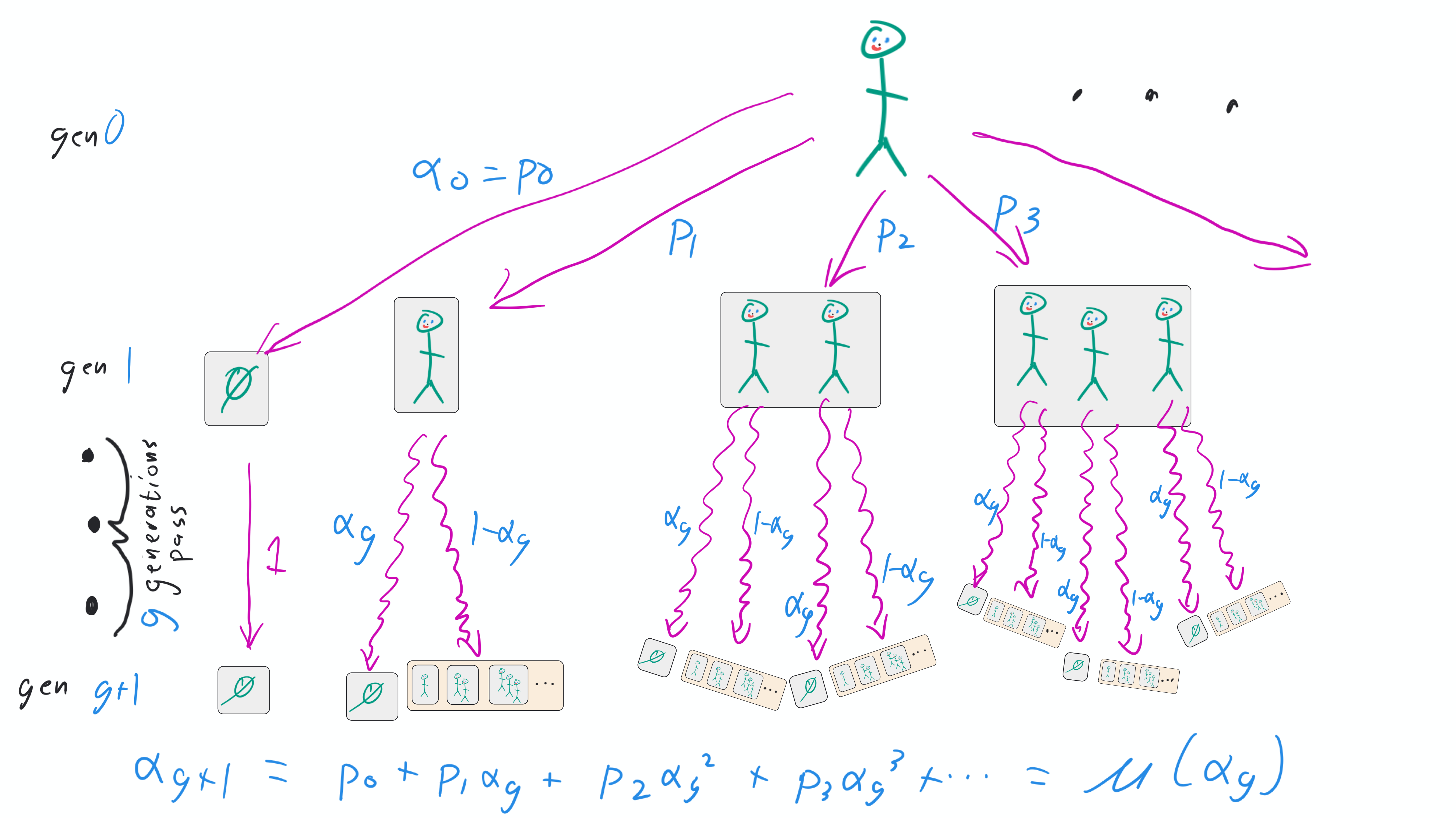
Much as when we calculated the extinction probability, we see that
with the initial value \(\alpha_0=0\).
Standard methods of discrete dynamical systems can be used to show that the iterative process will converge to some \(\alpha\) solving \(\alpha = \mu(\alpha)\) and having \(\mu'(\alpha)\leq 1\).
(consider review of Cobweb Diagrams)