

2.3. Differentiation and the Galton Watson Process#
Please read Section 1.6 prior to reading this section.
Consider A Galton-Watson process. Let \(\mu(x)\) be the PGF of the offspring distribution. We have learned that the extinction probability \(\alpha\) is a solution to the equation \(x = \mu(x)\).
In the plots given in Section 2.2, we saw two solutions to \(x=\mu(x)\). One was between \(0\) and \(1\) and another was equal to \(1\). We will learn later that if there is a solution \(x_0\) with \(x_0 = \mu(x_0)\) and \(0\leq x_0 <1\), that will be the correct solution for \(\alpha\). Otherwise, \(\alpha=1\) will be the correct solution.
For now, we’ll try to find conditions for which there is guaranteed to be a solution \(0 \leq \alpha <1\) and for which there no such solution. This will determine whether \(\alpha=1\) in which case extinction is guaranteed or \(\alpha<1\) in which case long-term persistence is possible.
Intuitively, we might expect that extinction is guaranteed if the expected number of offspring is less than \(1\). Our results about the moments of \(\mu(x)\) in Section 1.6 show that the expected number of offspring is \(\mu'(1)\). This observation provides us a mathematical handle that we can use to produce a rigorous proof verifying our expection.
Before attempting the proof, we plot the line \(y=x\) and the curves \(y = \mu_\lambda(x)\) for a Poisson distribution with mean \(\lambda\) to strengthen our intuition.
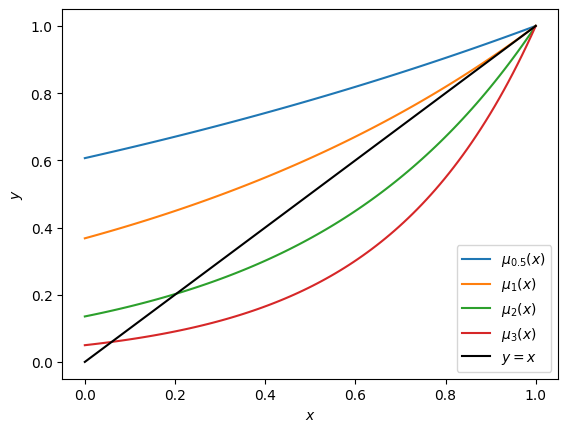
We see that for these cases each \(\mu(x)\) is a convex function, and \(\mu(0)>0\). As noted before \(\mu(1)=1\). The plots that have slope greater than \(1\) at \(x=1\) have \(\mu(x)<x\) for sufficiently large values of \(x<1\), and then they cross \(y=x\) at some smaller value of \(x\). The plots that have slope less than (or equal to) \(1\) at \(x=1\) have a shallower slope for \(x<1\), and so they remain above \(y=x\) for smaller values of \(x\).
Now we’ll try to make these observations more general beyond the handful of plots shown here. To avoid the awkward case of \(\mu(x)=x\) we will focus just on \(\mu'(1)<1\) or \(\mu'(1)>1\).
We first look at the case where \(\mu'(1) < 1\), then \(\mu(x)-x\) is positive for values of \(x\) close enough to but less than \(1\). Since \(\mu(x)\) is a polynomial with non-negative coefficients, \(\mu'(x) \leq \mu'(1)\) for \(0< x < 1\), so \(\mu(x)-x\) is a decreasing function in this interval. As it equals \(0\) at \(x=1\), it must be positive for \(0 \leq x <1\). So there is no other solution in \(0 \leq x <1\).
However if \(\mu'(1) > 1\), then \(\mu(x) - x<0\) for \(x<1\) close enough to \(1\). Further \(\mu(0)\) must be non-negative so \(\mu(x)-x \geq 0\) at \(x=0\). In the case that \(\mu(x)-x=0\) at \(x=0\), we have found a solution \(x = \mu(x)\) at \(x=0\). In the case that \(\mu(x)-x>0\) at \(x=0\), we note that \(\mu(x)-x\) is a continuous function that is positive at \(x=0\) and negative for large enough \(x<1\). Thus there must be some point \(\alpha\) with \(0<\alpha<1\) where \(\mu(\alpha)-\alpha=0\), that is \(\alpha=\mu(\alpha)\).
Thus we see that if \(\mu'(1)<1\) then extinction is guaranteed (\(\alpha=1\) is the only solution), while if \(\mu'(1)>1\), there is a solution \(0\leq \alpha<1\) which means that extinction is not guaranteed.
As we have noted above, \(\mu'(1)\) is the average of the distribution, that is the expected number of offspring. So extinction is guaranteed if the average number of offspring is less than \(1\), but if the expected number is greater than \(1\), then long-term persistence is possible.
We have proven a Theorem:
Theorem 2.2 (Galton-Watson extinction threshold)
Given a Galton-Watson process whose offspring distribution has PGF \(\mu(x)\):
If \(\mu'(1)<1\), then extinction is guaranteed.
If \(\mu'(1)>1\), then long-term persistence (that is, never going extinct) is possible.
In the case of long-term persistence, we typically see exponential growth.
As presented, the theorem did not address \(\mu'(1)=1\). It is possible to handle this possibility. We need to separate it into two cases: \(\mu(x)=x\) and \(\mu(x) \neq x\). If \(\mu(x)=x\), then long-term persistence is guaranteed. If \(\mu'(1)=1\) and \(\mu(x) \neq x\), then extinction is guaranteed (but it may take a very long time).
2.3.1. Self-test#
Explain why \(\mu(0)=0\) is equivalent to \(p_0=0\). If \(p_0=0\), explain why long-term persistence of a Galton-Watson process is guaranteed.
If \(\mu(x)\) is a PGF and \(\mu'(1)=1\) and \(\mu(x)\) is not the function \(y=x\), explain why \(\mu'(x)<1\) for any \(x\) in \((0,1)\). Repeat the argument in the text to explain why \(\alpha=1\) is the only possible solution for the long-term extinction probability.